
 Kapcsolat
 Hogyan vásároljunk

Kézbesítés
Vásárlási tanácsadó
 Angol
 38 b
Akár 30 napos visszaküldési lehetőség

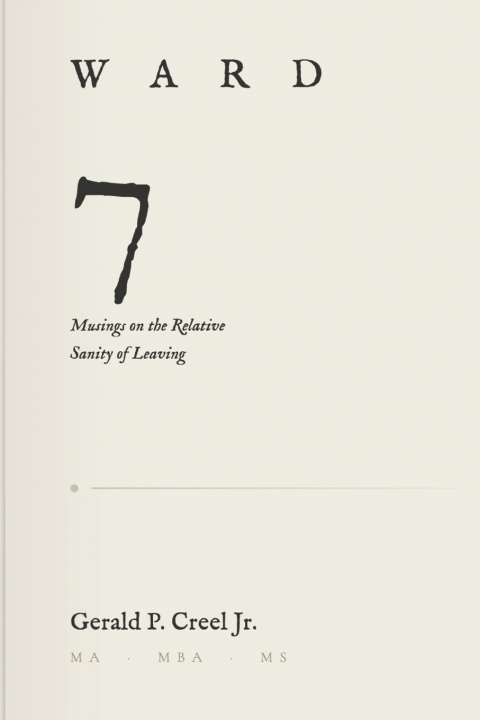
Ward 7
Musings on the Relative Sanity of Leaving
What if the sanest decision a man could make was to check himself into a psychiatric facility?
That is precisely the calculation Gerald P. Creel Jr. makes in this razor-sharp work of satirical fiction - with the methodical precision of a man who holds three graduate degrees, a clinical counseling background, and forty-five years of watching institutional life fail in ways that are both predictable and spectacular.
The plan is elegant. A voluntary admission. A room with a window. Three meals a day served at predictable intervals by people who are not trying to sell him anything. A button on the wall that summons a human being whose entire professional function is to ensure his continued survival - a service that no board, no chamber, no governor's office, and no HR department has ever reliably provided.
Ward 7 moves through the architecture of institutional life with the precision of a scalpel and the timing of a seasoned comedian. The narrator catalogs the ward's residents - the grandiose visionary, the institutional martyr, the consensus-dependent, the weaponized fragility operator - and finds that every pathology on the charts has a direct counterpart in the boardrooms, chambers, and strategic planning retreats he has spent a career navigating. The diagnoses are the same. Only the lanyards are different.
Along the way, he executes a tactically precise eviction of a fellow patient from the ward's only green beanbag chair. He walks through the lobby during a federal accreditation inspection with the ceremonial gravity of a man who has calculated the institutional response in advance and found it favorable. He games the discharge timeline with the same resource-allocation logic he applied to every budget he has ever managed. He attends group therapy twice a week and finds it, without qualification, the most honestly functioning meeting of his thirty-year professional life.
And in the quiet spaces between - at the medication window each morning, in conversations with a night-shift nurse named Patricia who delivers the most accurate diagnosis in the book at two-thirty in the morning - he arrives at something the outside world has never managed to provide.
Stillness. Honesty. The particular freedom of a man who has finally stopped pretending.
Ward 7 is for anyone who has sat in a meeting and thought: something is genuinely wrong with this picture. It is for the person who has filed the mission statement, attended the retreat, submitted the quarterly objectives, and emerged more depleted than when they entered. It is for everyone terminated with cause for doing their job, wished all the best by people who were done with them, or handed a folder of outpatient resources by someone named Beverly who means well.
It is, above all, for the man at table four - the one who folded his candy bar wrapper into a very small square and waited the full two hours - because no one saw him, and the seeing mattered, and it needed to be written down.
Animated by the sardonic clarity of a man who has read Chekhov, survived senators, and eaten enough institutional soup to have opinions about it, Ward 7 reaches a conclusion that is neither cynical nor naively optimistic: the world is not going to fix itself. But there is a place to stand. And from there, you can see it clearly.
Seeing clearly, in a world engineered for opacity, is an act of revolution.
Vanity of vanities. All is vanity. The soup was good.


Információ a könyvről
Angol

Ajándékozza oda ezt a könyvet még ma
Nagyon egyszerű
1 Tegye a kosárba könyvet, és válassza ki a kiszállítás ajándékként opciót 2 Rögtön küldjük Önnek az utalványt 3 A könyv megérkezik a megajándékozott címéreSzia! Libroamiko vagyok, a könyvtanácsadód.
Miben segíthetek?