
 Kapcsolat
 Hogyan vásároljunk
Kézbesítés
Vásárlási tanácsadó
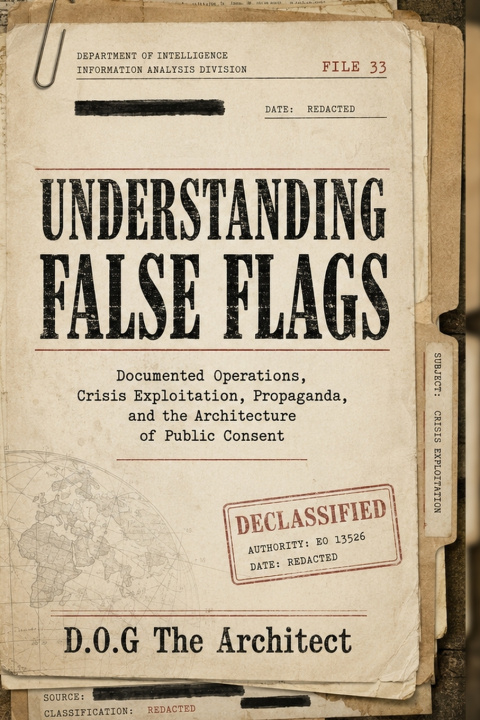
Understanding False Flags
Documented Operations, Crisis Exploitation, Propaganda, and the Architecture of Public Consent
 Angol
Angol
 71 b
71 b
 Új
Új
30 nap a termék visszaküldésére

UNDERSTANDING FALSE FLAGS
The Enemy They Needed
By D.O.G The Architect
Power does not always need truth.
Sometimes it only needs an enemy.
From the Reichstag Fire to Operation Northwoods...
from Gulf of Tonkin to Iraq WMD...
from media manipulation and cyber warfare to psychological operations and engineered fear...
Understanding False Flags is a dark, forensic investigation into how crises are used, shaped, amplified, and weaponized to manufacture consent, redirect public emotion, expand state power, and reshape history.
This is not a book of blind conspiracy theories.
It is a study of:
- documented operations
- proposed false-flag plans
- exploited emergencies
- psychological warfare
- media narratives
- cyber manipulation
- intelligence operations
- and the machinery of fear itself
Inside this dossier-style investigation, you will uncover:
- The anatomy of a false flag
- Why power needs enemies
- How emergency psychology overrides critical thinking
- The classic historical operations that changed nations
- Intelligence infiltration and war consent
- Media, cyber, and grey-zone manipulation
- The role of narrative control in modern conflict
- How fear becomes policy
- Why confusion itself can become a weapon
- The hidden architecture behind permanent crisis systems
This book does not ask you to believe everything.
It asks you to examine patterns.
Through cinematic case studies, declassified operations, propaganda analysis, psychological breakdowns, and strategic pattern recognition, Understanding False Flags explores one of the darkest questions in modern history:
When fear becomes infrastructure...
who benefits from the panic?
Dark, unsettling, and relentlessly analytical, this book is written for readers interested in:
- geopolitics
- intelligence agencies
- propaganda
- psychological warfare
- media manipulation
- covert operations
- power structures
- strategic deception
- and the hidden mechanics of modern control systems
Not conspiracy.
Pattern recognition.
Question the narrative.
Recognize the pattern.
Defend reality.
Author's Disclaimer and Statement of Responsibility
Author's Disclaimer and Statement of Responsibility
Understanding False Flags: The Enemy They Needed is a nonfiction work of historical analysis, public-record commentary, media criticism, and speculative scenario analysis.
This book does not claim that every tragedy is staged, every crisis is fake, or every official account is false. It does not deny real victims, real suffering, real acts of terrorism, real acts of war, documented genocides, public massacres, or historically established crimes.
Note: This book is a nonfiction historical and analytical study of false flags, crisis exploitation, propaganda, intelligence failures, public-record controversies, and future scenario analysis. It does not claim that every tragedy is staged, does not deny real victims or documented atrocities, and rejects harassment, hate speech, violence, terrorism, genocide denial, and unsupported accusations. Future scenarios are clearly presented as fictional recognition exercises, not factual predictions.


Információ a könyvről
Angol
