
 Kapcsolat
 Hogyan vásároljunk
Kézbesítés
Vásárlási tanácsadó
 Angol
Angol
 62 b
62 b
 Új
Új
30 nap a termék visszaküldésére

There are books that explain the world.
There are books that critique it.
And then there are rarer books that quietly reorient how the world is perceived.
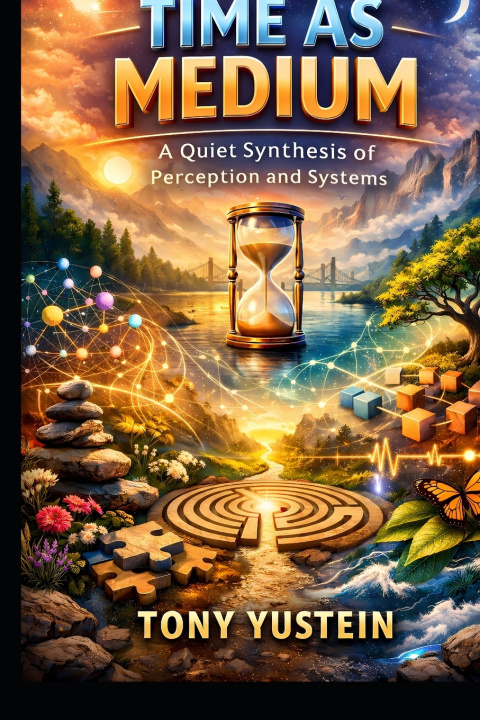
Time as Medium: A Quiet Synthesis of Perception and Systems belongs unmistakably to that last category.
Written by Tony Yustein, this is not a manifesto, a spiritual treatise, or a speculative science book dressed in metaphor. It is a disciplined, unusually clear examination of how time, perception, and systems interact beneath the narratives we are accustomed to using. Yustein does not argue for belief. He does not promise insight as reward. He does something far more demanding: he shows how coherence operates when urgency is removed.
What distinguishes this book immediately is its restraint. In an age dominated by acceleration, prediction, and performance, Time as Medium refuses to compete for attention. Instead, it maps the structures that quietly shape attention itself. Drawing from systems thinking, overlooked scientific intuitions, economic observation, and human experience, the book reveals a recurring pattern: when perception becomes coherent, time stops behaving like pressure and begins to function as an environment.
Readers will find no jargon-laden theory and no simplified self-help conclusions. The prose is precise, calm, and unhurried. Each chapter builds carefully, allowing ideas to settle rather than stack. Complex subjects are handled without dramatization, and controversial terrain is crossed without provocation. The result is a work that feels both rigorous and deeply humane.
Yustein's strength as an author lies in his refusal to inflate his role. He positions himself neither as teacher nor guide, but as a careful observer tracing connections others tend to leave fragmented. The synthesis presented here does not demand adoption. It remains available, practical, and quietly durable.
This book is especially recommended for readers who sense that something essential has been lost in the constant rush to explain, optimize, and conclude. For those who feel that modern life treats time as an enemy rather than a medium, this work offers a rare alternative: not escape, not resistance, but orientation.
Time as Medium does not end with answers. It ends with stability. And for many readers, that will feel like exactly what has been missing.


Információ a könyvről
Angol
Kategória
