
 Kapcsolat
 Hogyan vásároljunk
Kézbesítés
Vásárlási tanácsadó
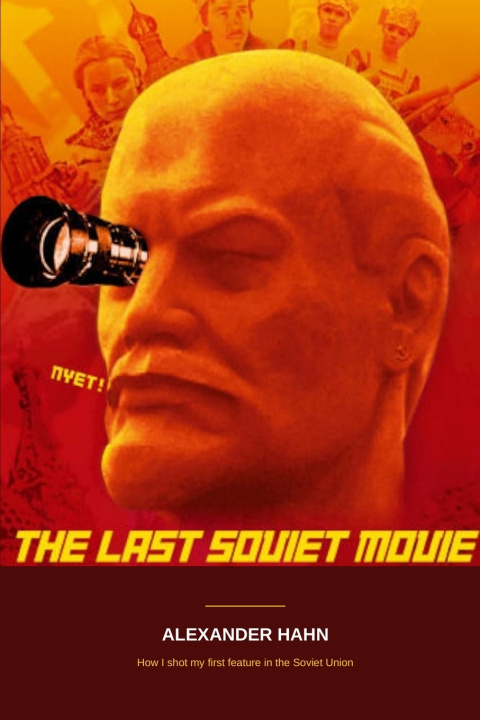
The Last Soviet Movie
 Angol
Angol
 39 b
39 b
 Új
Új
Akár 30 napos visszaküldési lehetőség

Riga, 1990. A student at the Vienna Film Academy goes back to the country he was born in to make his first feature. He has a screenplay written in four days at his grandmother's kitchen table, twenty thousand marks out of his father's severance pay, and a contract with a Soviet film studio.
What he does not have: enough film stock, a leading actress who stays, and a country that lasts until the end of the shoot.
The shoot begins in April 1991 in Kupanskoye, a village north of Moscow. A twenty-three-year-old directs in a language he speaks but cannot spell, with a crew in which most people are twice his age and nobody asks him before they saw down the power poles to make the village look like 1916. Half the village goes three days without electricity so that one shot will be right.
After two weeks the leading actress does not turn up. She is in Moscow, shooting with Malcolm McDowell. Months later, in Latvia, the part is cast a second time and half a finished film is thrown away to get half a film back. In between, tanks come out in Moscow, the currency is exchanged overnight, and the state the film was licensed in stops existing.
The crew came from the Riga Film Studio and from Mosfilm. The stuntman who fought the wolves was short and heavy and looked nothing like the actor he was doubling - it does not show, because when there are wolves in the shot nobody looks at the man. The bandit of 1916 was played by a man who had been the last prisoner held in the KGB building in Riga. Most of them had spent their working lives in an industry that stopped existing six months later.
In September 1992 a young man carries twenty-three kilos of celluloid onto a ship to Kiel.
THE LAST SOVIET MOVIE is the account of how that film was made and what became of it. It is also the story of the Russian director listed in the credits who never existed, whose name the author invented and cannot get off the internet thirty years later. Of subtitles that say something other than the dialogue. Of a projectionist in a small German cinema who taught the author more than two semesters of theory did. Of a crane that travelled from Moscow at walking pace because the roads allowed nothing else. And of the cigarette an actor smokes so that his breath will not show at minus eighteen degrees.
The book begins earlier and ends much later. It begins in Augsburg in the mid-eighties with a boy from Riga who is useful because he speaks Russian. He interprets at a film festival, and one evening he speaks a Latvian documentary live into a dark hall, in front of two hundred people - and puts in a sentence that is not in the film. A woman in the audience cries. Nobody notices. It ends with the same film running on Netflix, under a title it did not have when it was shot, in the version with the wrong subtitles.
Alexander Hahn does not explain how cinema works. He shows what films are made of, and he does not leave himself out: the invented director, the faked subtitles, the opening text that turns two parades into a conflict. The film won the Gold Special Jury Award in Houston and the prize for best first work in Alexandria. Its director was at neither festival.
With 64 photographs from the author's own archive.
For readers who do not only watch films, but want to know what they are made of.


Információ a könyvről
Angol

Ajándékozza oda ezt a könyvet még ma
Nagyon egyszerű
1 Tegye a kosárba könyvet, és válassza ki a kiszállítás ajándékként opciót 2 Rögtön küldjük Önnek az utalványt 3 A könyv megérkezik a megajándékozott címéreSzia! Libroamiko vagyok, a könyvtanácsadód.
Miben segíthetek?