
 Kapcsolat
 Hogyan vásároljunk
Kézbesítés
Vásárlási tanácsadó
 Angol
Angol
 37 b
37 b
 Új
Új
30 nap a termék visszaküldésére

The Mind Never Stops - And That is the Problem
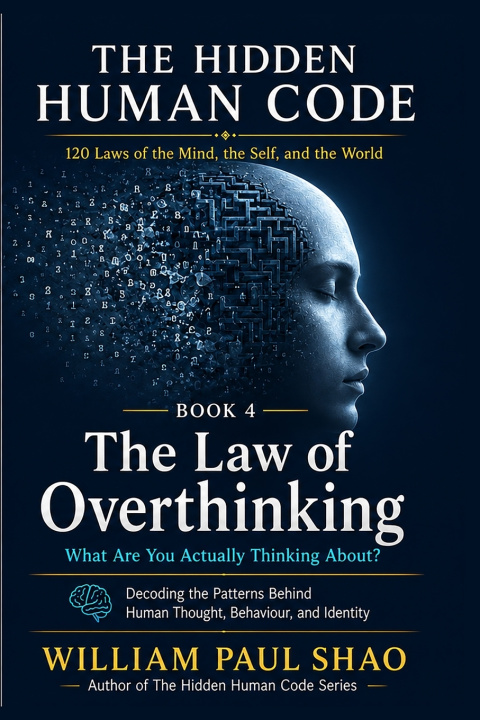
At 2:47 a.m., unable to stop thinking, you confront the central question of The Law of Overthinking: what are you actually thinking about? In this fourth volume of The Human Code, William Shao explores how overthinking disguises itself as intelligence, caution, and clarity while quietly trapping people in endless mental loops.
Using the story of Daniel, a Nairobi project manager paralysed by a simple career decision, the book argues that overthinking is not deep thinking but the illusion of progress. Drawing from psychology, neuroscience, philosophy, and history, Shao explains that the human brain evolved to anticipate danger and model outcomes-a useful survival tool that becomes destructive in modern life when every decision feels existential.
The book combines research from psychologists and neuroscientists with historical examples ranging from Charles Darwin's delayed publication of evolution to Julius Caesar ignoring warnings before his assassination, Kodak suppressing digital photography, and Franz Kafka wanting his manuscripts destroyed. Across centuries and cultures, the same pattern emerges: too much thinking often prevents action.
A major contribution of the book is its breakdown of the "six disguises" of overthinking-thoroughness, caution, emotional processing, complexity, self-awareness, and consideration for others-and its six common overthinker types, including the Analyst, Anticipator, Retrospector, Perfectionist, Ruminator, and Social Decoder. Most people move between these patterns depending on stress and circumstance.
Scientifically, the book explains how the amygdala, default mode network, and stress hormones create a self-reinforcing cycle of rumination. Shao argues that overthinking is not a malfunction but the brain operating exactly as designed. The solution is not more thought, but changing the conditions under which thoughts occur through focused action, flow states, mindfulness, and engagement with life.
Threaded through the book is the mythology of the Architects, the ancient civilisation central to the series, who introduce the idea of the "Still Centre"-a quieter place beneath mental noise where certainty already exists. The book's core challenge asks: if you already knew the answer, what would you do with all the time spent searching for it?
Rigorous yet deeply personal, The Law of Overthinking is written for anyone who has replayed conversations at midnight, delayed decisions for weeks, or mistaken constant mental activity for control. Rather than promising silence, it offers understanding: you are not the room of thoughts you live in, and beneath the noise, something steadier has been there all along.


Információ a könyvről
Angol
