
 Kapcsolat
 Hogyan vásároljunk
Kézbesítés
Vásárlási tanácsadó
 Angol
Angol
 39 b
39 b
 Új
Új
30 nap a termék visszaküldésére

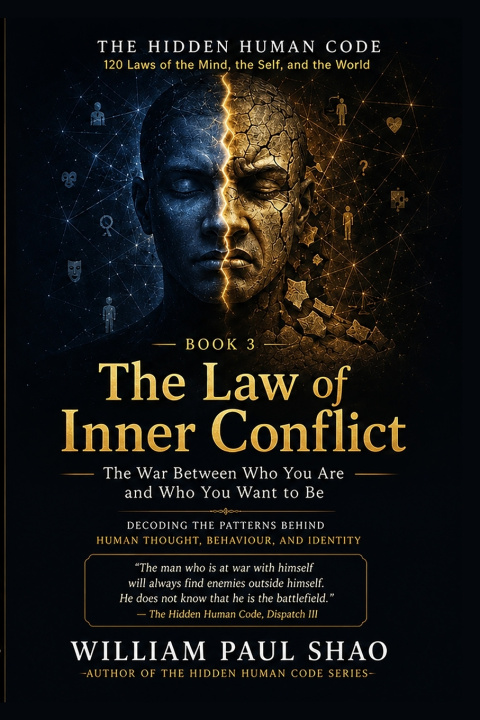
What if the greatest battle of your life is not with the world-but within yourself?
The Law of Inner Conflict is the third book in The Hidden Human Code, a 120-book series exploring the hidden laws of the human mind, identity, and behaviour. Building on the first two books, this volume examines the silent war between who you are and who you could become.
The book begins with an ordinary man frozen in indecision: an unfinished job application, a phone call never made, a gym bag packed for months. His paralysis is not laziness, but the result of two competing versions of himself battling for control. Through this story, the book argues that many of life's greatest struggles are internal, not external.
Drawing from psychology, neuroscience, history, and philosophy, the book explains how inner conflict works. It explores psychologist Kurt Lewin's three forms of motivational conflict, the tension between the "public self" and the hidden self, and the brain systems involved in mental paralysis and overthinking. Historical figures such as Mahatma Gandhi, Abraham Lincoln, Leo Tolstoy, Charles Darwin, and Nelson Mandela are used to show that even extraordinary lives were shaped by unresolved inner wars.
The book also identifies two major traps that keep people stuck for years. The first is the "Glass Room"-believing you fully understand yourself while never actually changing. The second is "winning the wrong battle" by suppressing one side of yourself for comfort or approval, only for resentment and regret to emerge later in life.
Rather than offering simple motivational advice, The Law of Inner Conflict provides a framework for understanding the structure of inner struggle and learning how to integrate conflicting parts of yourself instead of destroying one side to protect the other. Its central message is that peace does not come from eliminating conflict, but from understanding it correctly.
The book closes with a haunting question for every reader:
How long are you willing to let the trial be postponed?
Book 4 - The Law of Overthinking-is coming.


Információ a könyvről
Angol
