
 Kapcsolat
 Hogyan vásároljunk
Kézbesítés
Vásárlási tanácsadó
Same Words for Your Dog
Alone at Home: Reward-Based Training for Time Spent Alone
 Angol
Angol
 25 b
25 b
 Új
Új
Akár 30 napos visszaküldési lehetőség

Every situation in this book names its source - a named study or a veterinary position statement, printed on the page, not a branded method and not a clip somebody shared.
The hardest part of this one happens while you are not there. The door closes and the barking starts. You come home to a chewed door frame, a puddle in a dog who is clean all week, or a message from the neighbor. This book tells you what to say, what to change, and what you should be seeing a week later.
Forty-five situations about a dog who has to be left alone, each on one spread: where he stays and how much space, the shape of the day around the absence, the first step out of sight, sixty seconds behind a closed door, adding time without jumps, the keys and shoes he already reads, a goodbye that is not an event, the greeting when you get in, putting a camera up and what the first twenty minutes tell you, settled against quiet and shut down, barking at the hallway, howling, boredom noise, what to leave on and what to block, talking to the neighbors before they complain, bark collars and why not, chewing at the door against chewing from boredom, scratching at doors, puddles only when he is alone, getting out of the crate, dog-proofing the room, workdays longer than a dog can do, walkers and daycare, why a second dog is not the fix, working from home, going back to the office, the parked car, real separation distress, medication and the conversation with your vet, and when to call a professional.
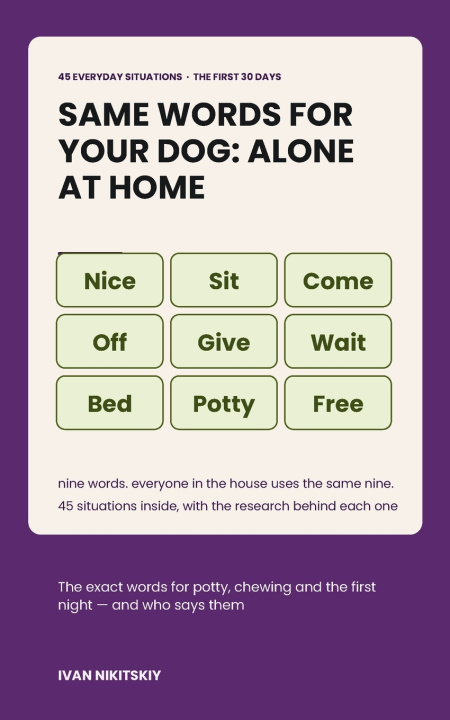
Nine words, and everyone in the house uses the same nine. One word means one thing and never two. The list is printed at the front, and every spread says which of the nine it uses. The same nine run through every book in the series.
The research behind every page is named. The American Veterinary Society of Animal Behavior on humane training and on aversive collars. The American Animal Hospital Association on routine, management and referral. Around them: Rehn and Keeling on what half an hour, two hours and four hours actually did to twelve dogs; Butler and colleagues on graded absences that worked in eight; Palestrini and colleagues on what a camera showed in twenty-three homes; Flannigan and Dodman on what separated four hundred dogs into two groups; Pongracz and colleagues on what people hear in a bark.
It also says where the evidence is thin. No study sets a maximum time a dog can be left, and this book says so instead of quoting a number as though one did. One page rests on an absence of association rather than a finding, and says that too. Where a source was funded by a company with something to sell, that is disclosed at the back with the company named.
No brand of food, crate, camera or collar is named anywhere in it.
Separation distress is a diagnosis, not a training gap, and the pages that touch it send you to a veterinarian rather than to another week of trying.
Book three of Same Words for Dogs, and it stands alone.
Educational material. Not veterinary advice.

Információ a könyvről
Angol

Ajándékozza oda ezt a könyvet még ma
Nagyon egyszerű
1 Tegye a kosárba könyvet, és válassza ki a kiszállítás ajándékként opciót 2 Rögtön küldjük Önnek az utalványt 3 A könyv megérkezik a megajándékozott címéreSzia! Libroamiko vagyok, a könyvtanácsadód.
Miben segíthetek?