
 Kapcsolat
 Hogyan vásároljunk
Kézbesítés
Vásárlási tanácsadó
 Angol
Angol
 30 b
30 b
30 nap a termék visszaküldésére

Why do arguments fail to settle disagreement-even when they are sound?
Why does modern discourse feel angry, coercive, and unstable, even when it claims to value reason and evidence?
And by what authority does anyone judge belief at all?
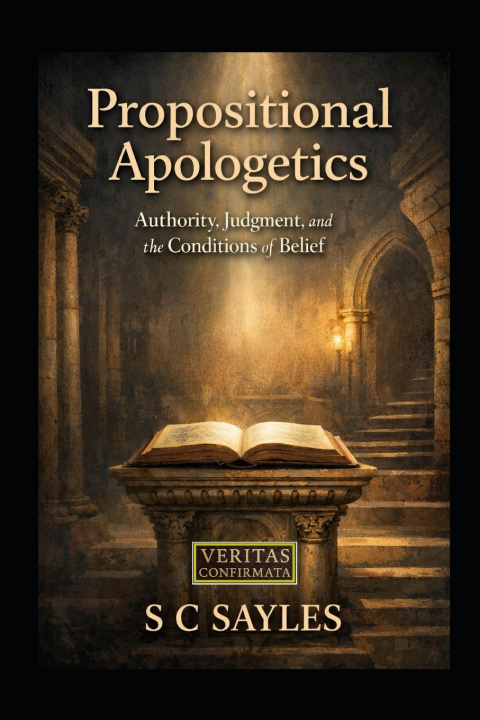
In Propositional Apologetics: Authority, Judgment, and the Conditions of Belief, philosopher-theologian S. C. Sayles argues that the central failure of modern apologetics is not intellectual weakness, lack of evidence, or poor reasoning-but a deeper confusion about authority.
Apologetics, Sayles contends, has asked arguments to do work they cannot do. Classical proofs, evidential reasoning, and presuppositional analysis can explain, persuade, and expose inconsistency-but they cannot, by themselves, judge. Judgment requires jurisdiction. And jurisdiction, in modern discourse, is almost always assumed, concealed, or denied.
This book does not offer another apologetic system. It does not attempt to "win debates," accumulate proofs, or force assent. Instead, it asks a prior and more fundamental question:
By what right does any claim bind under disagreement?
Through careful philosophical analysis and disciplined restraint, Sayles re-examines classical apologetics, evidentialism, transcendental reasoning, and presuppositionalism-not as courts, but as witnesses. He shows why disagreement persists even when arguments succeed, why neutrality functions as concealed authority, and why judgment without a named court inevitably collapses into coercion.
At the centre of the work is a rigorous account of jurisdiction: the legitimate right to judge. Sayles distinguishes authority from power, procedure, consensus, expertise, and persuasion, exposing how modern philosophy evacuated authority while retaining judgment-producing a culture saturated with condemnation but starved of legitimacy.
Written with clarity, precision, and theological seriousness, Propositional Apologetics is not a manual for argumentation, but an architectural work that clarifies the conditions under which argument, evidence, and belief can meaningfully function at all.
This book is for readers who sense that something is deeply wrong with contemporary apologetics and public reasoning-but who also refuse shallow solutions. It is for those willing to confront the uncomfortable truth that judgment cannot exist without authority, and that authority must be named before it can be answered.
Apologetics does not fail because it argues too boldly.
It fails because it begins too late.


Információ a könyvről
Angol
