
 Kapcsolat
 Hogyan vásároljunk
Kézbesítés
Vásárlási tanácsadó
 Angol
Angol
 37 b
37 b
 Új
Új
30 nap a termék visszaküldésére

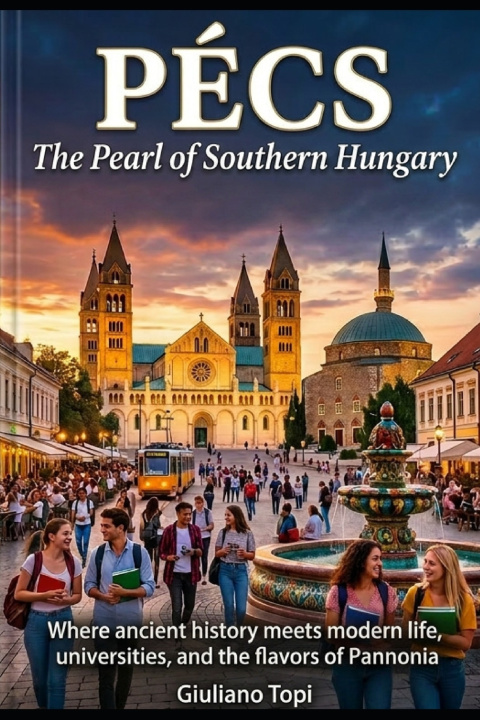
Thirty-one chapters that have attempted to tell the story of a city from its Roman foundations in the third century to the electric scooters that weave between the baroque palaces and Ottoman domes of today - from the frescoes painted by anonymous artists in limestone chambers beneath the earth to the light installations projected by contemporary designers onto the facade of a converted ceramic factory in October. Thirty-one chapters that have moved from the early Christian necropolis beneath the cathedral hill to the Villányi Franc in the wine cellars of the south, from the medieval university of 1367 to the twenty thousand students from a hundred and forty countries who fill the cafés of Király utca today, from the peaceable surrender of a bishop carrying the keys of the city to its Ottoman conquerors to the crescent and the cross that share, on the summit of the great green dome, a sky that neither tradition owns.
It has not been a simple story. No story of two thousand years is simple. Pécs has been destroyed and rebuilt and destroyed again. It has been Roman and Gothic and Ottoman and Habsburg and communist and European. It has been a city of scholars and a city of miners, a city of porcelain and a city of wine, a city of medieval faith and a city of Enlightenment libraries, a city of visionary painters who were not recognised in their lifetimes and a city of geometric artists whose works hang in the collections of the Tate and the Guggenheim. It has been, simultaneously and without apparent contradiction, all of these things at once.
What the visitor discovers, if they stay long enough and walk widely enough and sit in the cafés late enough to hear the city speak in its own voice, is that beneath all these layers and all these identities there is something that persists - something that has survived the Ottoman conquest and the Mongol invasion and the Treaty of Trianon and the communist nationalisation of the Zsolnay factory and the gradual depopulation of the coal-mining industry and every other form of historical damage that the twentieth century in particular was able to devise. It is a quality of place that is not reducible to any single monument or institution or tradition, a quality that the people of Pécs recognise and struggle to name - calling it mediterrán, calling it the spirit of a city without borders, calling it nothing at all but expressing it in the way they sit at the tables of their cafés in the evening and look at the Ottoman dome above their main square and feel, without needing to articulate it, that they live somewhere that is completely itself.
The writer of travel books must, eventually, stop writing and let the place speak for itself. The thirty-one chapters of this book have done what books can do: they have provided the context, the history, the practical information, the descriptive evocation of specific places and moments and atmospheres, that the traveller needs in order to arrive in Pécs with the eyes and the attention already partly calibrated to what they will find. But they cannot substitute for the experience itself - for the particular quality of the afternoon light on the Zsolnay fountain in October, for the sound of the cathedral organ filling the stone interior of a thousand-year-old church with harmonics that seem to come from the walls, for the smell of Harkány's sulphurous water on the skin hours after leaving the pool, for the taste of a good Villányi Franc with the last light of the day falling across a table in a wine cellar south of the Mecsek hills.
These things can only be experienced. And experiencing them is the only reason, in the end, to travel.


Információ a könyvről
Angol
