
 Kapcsolat
 Hogyan vásároljunk
Kézbesítés
Vásárlási tanácsadó
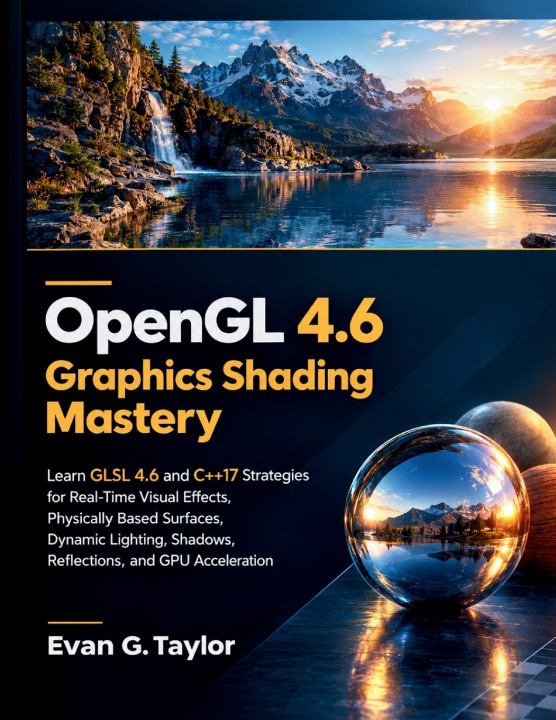
OpenGL 4.6 Graphics Shading Mastery
Learn GLSL 4.6 and C++17 Strategies for Real-Time Visual Effects, Physically Based Surfaces, Dynamic Lighting, Shadows, Reflections, and GPU Acceleration
 Angol
Angol
 79 b
79 b
 Hamarosan
 Új
Új
Akár 30 napos visszaküldési lehetőség

What if you could stop merely watching stunning real-time graphics and start understanding how they are created? What happens when you move beyond basic rendering and begin controlling light, shadows, reflections, surfaces, and visual effects directly on the GPU? And what if the skills needed to build those experiences could become practical, understandable, and achievable with modern C++17 and GLSL 4.6?
OpenGL 4.6 Graphics Shading Mastery: Learn GLSL 4.6 and C++17 Strategies for Real-Time Visual Effects, Physically Based Surfaces, Dynamic Lighting, Shadows, Reflections, and GPU Acceleration by Evan G. Taylor invites you to explore exactly that journey.
Are you ready to discover what really happens between your C++ application, your shaders, and the final pixels appearing on the screen? Do you want to understand how vertices become fragments, how shaders transform raw geometry into convincing scenes, and how the GPU can be directed to perform demanding visual calculations at remarkable speed?
Perhaps you have already experimented with OpenGL but found yourself asking: Why does my lighting look flat? Why do my shadows feel unrealistic? How can I create convincing reflections? What makes a surface appear metallic, rough, glossy, or smooth? How can I produce visual effects without overwhelming the CPU? And, most importantly, how do experienced graphics programmers approach these challenges?
This book is designed to turn those questions into practical understanding and confident graphics programming skills.
You will be encouraged to think beyond simply writing shader code. What is a shader really doing? How should C++17 and GLSL 4.6 work together? How can you organize your rendering pipeline so that your programs remain efficient, flexible, and easier to extend? When should a calculation happen on the CPU, and when is the GPU the better place to perform it?
As you explore modern shading techniques, you will encounter the principles behind physically based surfaces and ask an essential question: what makes a digital material behave convincingly under different lighting conditions? How do roughness, metallic properties, reflections, and illumination interact to create a believable appearance?
What about lighting? How can dynamic lights transform an ordinary scene into something visually compelling? How do shadows help establish depth and spatial relationships? What techniques can make reflections feel natural rather than artificial? And how can GPU acceleration help you achieve increasingly sophisticated results while maintaining real-time performance?
Rather than treating graphics programming as a collection of mysterious formulas and complicated shader instructions, this book encourages you to understand the reasoning behind the techniques.
Whether you are an aspiring graphics programmer, game developer, C++ enthusiast, computer graphics student, technical artist, or developer seeking deeper knowledge of modern OpenGL, you will find a focused path into the world of programmable graphics.
So, are you ready to ask better questions about rendering? Ready to understand what your GPU is capable of? Ready to move from simply displaying objects to creating surfaces, illumination, shadows, reflections, and effects that respond dynamically?
Open the book, start experimenting, challenge your understanding, and take your first serious step toward mastering OpenGL 4.6, GLSL 4.6, and C++17 for real-time graphics.
Your next visual masterpiece begins with a question: What can you create when you truly understand the GPU?


Információ a könyvről
Angol

Ajándékozza oda ezt a könyvet még ma
Nagyon egyszerű
1 Tegye a kosárba könyvet, és válassza ki a kiszállítás ajándékként opciót 2 Rögtön küldjük Önnek az utalványt 3 A könyv megérkezik a megajándékozott címéreSzia! Libroamiko vagyok, a könyvtanácsadód.
Miben segíthetek?