
 Kapcsolat
 Hogyan vásároljunk
Kézbesítés
Vásárlási tanácsadó
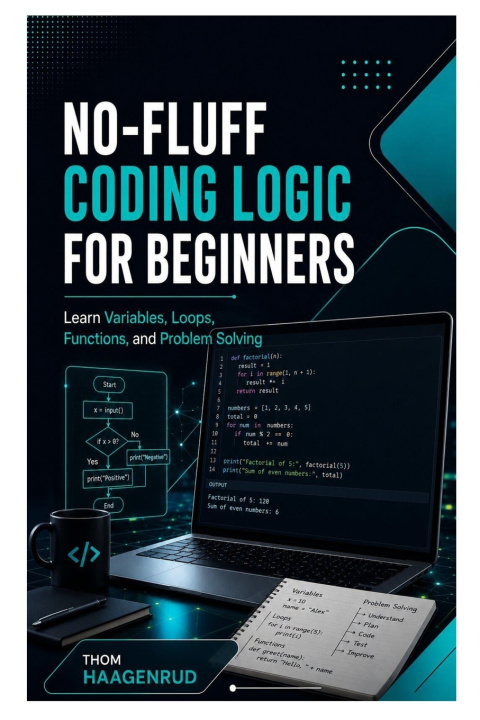
No-Fluff Coding Logic for Beginners
Learn Variables, Loops, Functions, and Problem Solving
 Angol
Angol
 46 b
46 b
 Hamarosan
 Új
Új
Akár 30 napos visszaküldési lehetőség

Do you want to learn programming without drowning in jargon, copied tutorials, or confusing explanations that move too fast?
No-Fluff Coding Logic for Beginners is a practical, beginner-friendly guide to understanding the thinking behind programming. Instead of rushing through syntax, libraries, frameworks, and oversized projects, this book teaches the core logic every beginner needs: how programs receive input, process data, make decisions, repeat work, use functions, handle errors, and grow into complete solutions.
Written for complete beginners, students, career switchers, working professionals, self-taught learners, and readers who have tried tutorials but still struggle when facing an empty file, this book focuses on the reasoning skills that transfer across programming languages. Python is used for the examples because its readable syntax keeps attention on the logic, but the concepts apply far beyond Python.
The book is organized around a deliberate progression. First, you build a programming mindset by learning how instructions, data, results, execution order, algorithms, and pseudocode work. Then you move into variables, values, expressions, input, output, decisions, loops, functions, parameters, return values, and scope.
After that, you learn how programs work with real data through lists, dictionaries, strings, validation, exception handling, debugging, and basic testing. Later chapters develop structured problem-solving skills, algorithmic patterns, program design, menu-driven workflows, and capstone projects.
The guided capstones bring the book together through three practical programs: a Personal Budget Tracker, a Student Grade Manager, and an Inventory and Sales Tracker. These projects help you combine variables, conditions, loops, functions, collections, validation, testing, summaries, and clean program structure into complete beginner-level applications.
This book also teaches the habits that help beginners become independent. You will learn to restate a problem, identify inputs, write sample cases, trace logic, test boundaries, use meaningful names, separate responsibilities, avoid hidden state, reject invalid input before changing data, and improve code only after it works.
No previous programming experience is required. You do not need advanced mathematics, a computer science qualification, or expensive equipment. Basic computer skills are enough: you should be comfortable creating folders, saving files, and opening applications.
Whether you are completely new to coding, returning after failed tutorials, learning Python, preparing for a first programming course, changing careers, or trying to strengthen weak fundamentals, this book gives you a direct route into practical coding logic.
Stop memorizing disconnected commands. Learn how to think through a problem, design the steps, trace the logic, write the code, test the result, and build small programs you can actually explain.


Információ a könyvről
Angol

Ajándékozza oda ezt a könyvet még ma
Nagyon egyszerű
1 Tegye a kosárba könyvet, és válassza ki a kiszállítás ajándékként opciót 2 Rögtön küldjük Önnek az utalványt 3 A könyv megérkezik a megajándékozott címéreSzia! Libroamiko vagyok, a könyvtanácsadód.
Miben segíthetek?