
 Kapcsolat
 Hogyan vásároljunk
Kézbesítés
Vásárlási tanácsadó
 Angol
Angol
 48 b
48 b
30 nap a termék visszaküldésére

In the rapidly growing field of artificial intelligence (AI) and machine learning (ML), the role of mathematics-particularly linear algebra and matrix computations-cannot be overstated. Every neural network, from the simplest perceptron to the most advanced convolutional neural network (CNN) or transformer model, is fundamentally built upon matrix and tensor operations. While researchers and engineers often interact with these operations indirectly through deep learning frameworks such as TensorFlow, PyTorch, or JAX, the efficiency, interpretability, and scalability of these systems depend directly on a deep understanding of matrix computations.
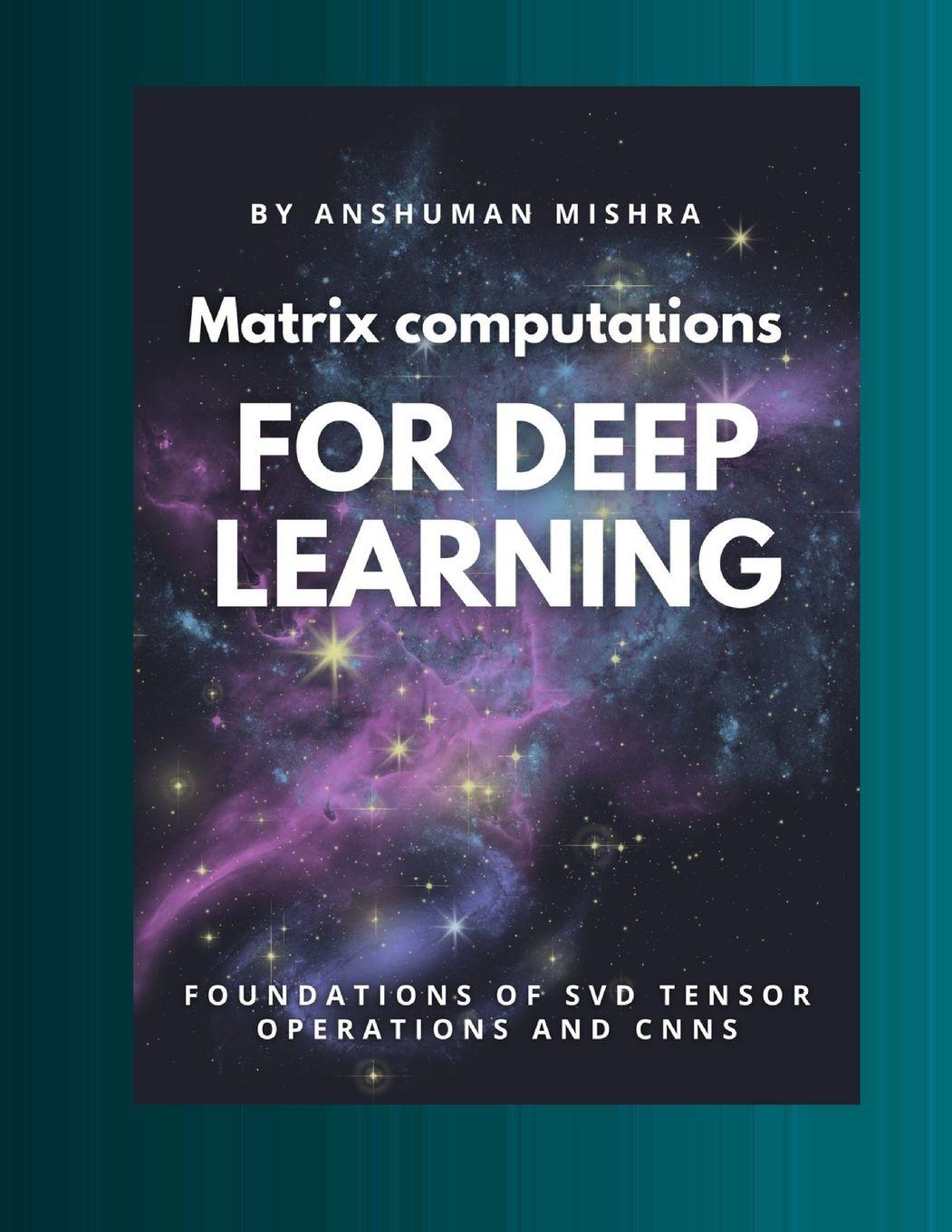
The book "Matrix Computations for Deep Learning" is written with the goal of bridging the gap between the theoretical foundations of matrix algebra and the applied techniques in deep learning. By focusing on singular value decomposition (SVD), tensor operations, and convolutional neural network foundations, this book provides students, researchers, and industry professionals with both the conceptual clarity and the practical skills necessary to design, implement, and optimize modern AI systems.
Why This Book is Needed
In most existing textbooks on deep learning, matrix computations are introduced briefly as a background requirement, often summarized in one or two introductory chapters. While this approach may provide enough to begin coding neural networks, it leaves a gap in understanding how these computations actually shape model performance, stability, and scalability.
For example:
- Singular Value Decomposition (SVD) is not just a mathematical trick; it is at the heart of data compression, dimensionality reduction, and optimization in deep learning.
- Tensor decompositions are not merely advanced algebraic tools; they enable model compression, multi-modal learning, and scalable architectures for big data.
- Convolutions, the backbone of CNNs, are more than a "sliding filter" - they can be fully understood as structured matrix multiplications that connect directly to Fourier transforms and wavelets.
How This Book is Structured
The book is divided into six major parts:
- Foundations of Matrix Computations - covering linear algebra basics, vector spaces, and norms that are directly applied in neural network optimization.
- Matrix Decompositions - exploring SVD, QR, LU, and eigenvalue decompositions with applications in dimensionality reduction, regularization, and optimization.
- Tensor Operations - moving beyond matrices to higher-order tensors, tensor decompositions, and computational efficiency in frameworks like PyTorch and TensorFlow.
- Matrix Computations for CNNs - showing how convolutions, pooling, and backpropagation can be represented entirely through structured matrix operations.
- Applications and Advanced Topics - linking matrix methods with dimensionality reduction, computer vision, and large-scale AI systems.
- Practical Implementations - providing hands-on coding examples in Python, with an emphasis on efficiency, stability, and scalability.
Why This Book is Important for Study
1. Building Mathematical Intuition for Deep Learning
Matrix computations are the foundation upon which deep learning is built. Without a solid grasp of these operations,


Információ a könyvről
Angol

Ajándékozza oda ezt a könyvet még ma
Nagyon egyszerű
1 Tegye a kosárba könyvet, és válassza ki a kiszállítás ajándékként opciót 2 Rögtön küldjük Önnek az utalványt 3 A könyv megérkezik a megajándékozott címéreSzia! Libroamiko vagyok, a könyvtanácsadód.
Miben segíthetek?