
 Kapcsolat
 Hogyan vásároljunk
Kézbesítés
Vásárlási tanácsadó
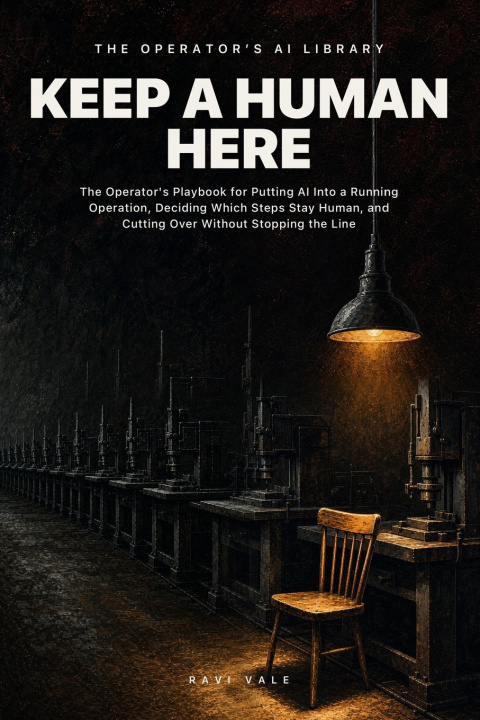
Keep a Human Here
The Operator's Playbook for Putting AI Into a Running Operation, Deciding Which Steps Stay Human, and Cutting Over Without Stopping the Line
 Angol
Angol
 121 b
121 b
 Új
Új
Akár 30 napos visszaküldési lehetőség

Between 2015 and 2020, the Australian government billed hundreds of thousands of its own citizens for welfare debts it could not prove they owed, sending automated demand letters that no person had checked before they went out.
A Royal Commission examined the scheme and delivered its final report on 7 July 2023. Per that report, Commissioner Catherine Holmes found it had been "devised without regard to the social security law," and that averaging a year's income across each fortnight "was essentially unfair, treating many people as though they had received income at a time when they had not." The Commission's own words are the ones to keep: "Robodebt was a crude and cruel mechanism, neither fair nor legal, and it made many people feel like criminals." The arithmetic was never the flaw. It ran exactly as written, at scale, on schedule. What went missing was the caseworker who used to verify a debt before the letter went out, not a task, a gate.
You are not writing welfare law. But if someone has handed you the plan to put AI into an operation that is already running, one with volume moving through it that cannot be paused while you rebuild it, you are one budget cycle from making the same decision. Keep a Human Here is the operator's playbook for making it on purpose instead. It replaces the seventy-five-year-old instinct to sort work into "what the machine is good at" and "what people are good at" with one working question, asked step by step: how much autonomy this step gets, where a human has to stay, and how to cut that over without breaking the line.
It is a field manual, not a lecture. Across seventeen chapters and nine appendices you build the case for every gate and then the tools to place and staff it:
- The process-mapping template. Draw the operation the way it actually runs, not the way it is drawn on the wall, without pausing it to look.
- The human-gate decision rule. A written rule that sets the autonomy level for each step and states why a given step stays human, defensible to your boss, your auditor, and yourself six months from now.
- The phased cutover plan. Move the redesign into production without stopping the operation for even an hour, with a rollback you have practiced before you need it.
- The vigilance and anti-complacency kit. Because a human standing at a step is not automatically a check. Some of the most expensive failures in this book had a person right there, watching, and the gate failed anyway.
- The governance evidence pack. What you show an auditor or regulator to prove the gate exists, has real authority, and is actually exercised.
The Refund Desk that recurs through the book, a customer-service returns queue worked chapter by chapter, is a disclosed composite built to carry one thread across the redesign, not a report of any real deployment.
This is a volume in The Operator's AI Library: for operators told to put AI into a process that is already live, who must decide where a human stays and prove they meant to. Readers of the author's Verifier's Library will know the discipline. That shelf asks whether an output can be trusted; this one asks whether the person watching it is actually positioned to catch it when it is wrong.


Információ a könyvről
Angol
Kategória
