
 Kapcsolat
 Hogyan vásároljunk

Kézbesítés
Vásárlási tanácsadó
 Angol
 69 b
 Új
Akár 30 napos visszaküldési lehetőség

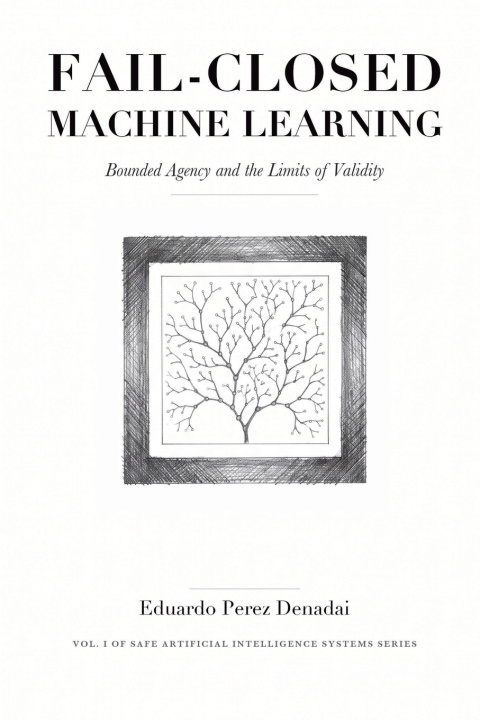
A predictive model answers what the outcome might be. It cannot answer whether it has the operational standing to decide.
Modern machine learning relies on total functions: mathematical estimators trained to emit a prediction for every coordinate in vector space, including unseen categories, corrupted telemetry, and inputs far outside the empirical support. In high-consequence environments-clinical triage, credit underwriting, fraud detection, and industrial control-treating every computable score as a license to act is a catastrophic design flaw.
In Fail-Closed Machine Learning, the foundational first volume of the Safe Artificial Intelligence Systems series, establishes the operational architecture of bounded agency: the requirement that an automated system's authority to act is strictly contained within its mathematically verified limits of validity.
A model may propose; a policy must dispose. This book provides the formal blueprints, mathematical proofs, and executable specifications to transition from total estimators to governed, partial decision contracts with a first-class refusal state.
What you will learn to build in this volume:
- The Admission Law & Contract Tuple: Replace brittle confidence thresholds with the formal contract tuple ⟨R, P, M⟩. Enforce the four-verdict state algebra (release, ask, deny, abstain) under strict precedence (deny ≻ ask ≻ release), where default release is structurally forbidden.
- The Spatial Boundary & Regime Floors: Construct empirical support envelopes (axis-aligned boxes, Mahalanobis ellipsoids, and isolation forests) and diagnostic violation vectors to intercept out-of-regime coordinates before inference.
- Finite-Sample Conformal Guarantees: Construct split-conformal prediction sets and derive the per-group conformal floor to guarantee distribution-free coverage and convert singleton sets into verified certification facts.
- Group Calibration & Continuous Envelopes: Implement Mondrian calibration to prevent subgroup coverage collapse, and deploy Conformalized Quantile Regression (CQR) with pinball loss to handle heteroscedasticity.
- Cohort Conformal Risk Control (CRC): Select dual release and deny thresholds on a unified grid to bound expected cohort loss under bounded loss functions, separating marginal risk from selection risk.
- Decision Economics & Chow Reject Bands: Derive analytic release and deny bands from institutional costs, prove the harmonic mean review threshold, and compile review queue capacity directly into policy intermediate representations.
- Air-Gapped Audit Replay: Emit cryptographically bound, immutable JSON decision records that auditors can verify and replay without loading model weights or machine learning libraries.
Written for machine learning engineers, risk officers, quantitative researchers, and technical auditors, this volume assumes only elementary probability and supervised learning. Every theoretical formulation is matched with language-neutral pseudocode and verified against the open-source mjolnir_ml Python reference library.
Stop relying on ungrounded model confidence. Equip your production pipelines with the spatial boundary of containment-and build automated systems that know when they must refuse to act.


Információ a könyvről
Angol

Ajándékozza oda ezt a könyvet még ma
Nagyon egyszerű
1 Tegye a kosárba könyvet, és válassza ki a kiszállítás ajándékként opciót 2 Rögtön küldjük Önnek az utalványt 3 A könyv megérkezik a megajándékozott címéreSzia! Libroamiko vagyok, a könyvtanácsadód.
Miben segíthetek?