
 Kapcsolat
 Hogyan vásároljunk
Kézbesítés
Vásárlási tanácsadó
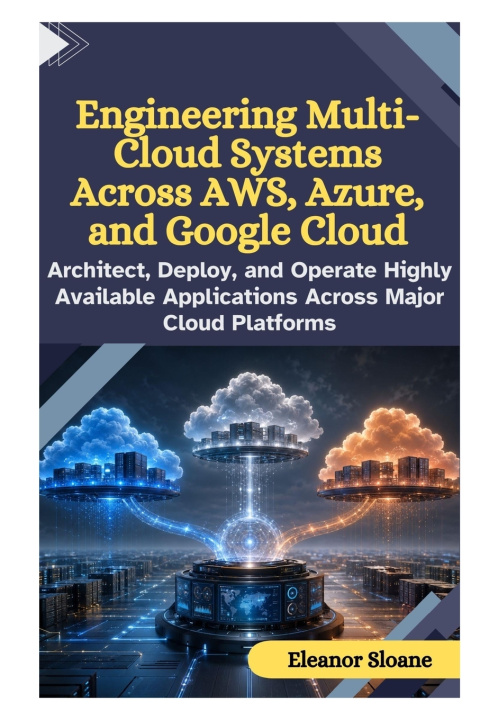
Engineering Multi-Cloud Systems Across AWS, Azure, and Google Cloud
Architect, Deploy, and Operate Highly Available Applications Across Major Cloud Platforms
 Angol
Angol
 46 b
46 b
 Hamarosan
 Új
Új
Akár 30 napos visszaküldési lehetőség

Using more than one cloud provider is easy to describe. Engineering those environments to behave as one dependable system is much harder.
Engineering Multi-Cloud Systems Across AWS, Azure, and Google Cloud provides a practical framework for designing, deploying, securing, automating, and operating applications across the three major cloud platforms.
Rather than treating AWS, Microsoft Azure, and Google Cloud as interchangeable collections of services, this book focuses on the infrastructure problems they solve and the architectural decisions that determine whether a multi cloud environment remains reliable, secure, manageable, and cost effective.
You will begin by understanding what multi cloud architecture actually means, why organizations adopt it, and when the additional complexity is justified. You will compare distributed workload designs, primary and recovery cloud models, active passive architectures, active active systems, and service specific strategies while learning why complete provider independence is rarely a useful goal.
From there, you will learn how to:
• Structure AWS accounts, Azure subscriptions, and Google Cloud projects
• Establish secure administrative environments across providers
• Apply least privilege to users and workloads
• Work with IAM roles, managed identities, service accounts, and temporary credentials
• Protect application secrets without embedding permanent credentials
• Design non overlapping network address spaces
• Plan routing, DNS, firewalls, private connectivity, and cross cloud communication
• Compare virtual machines, managed compute, and serverless options
• Deploy the same application across several providers
• Run portable containerized workloads on EKS, AKS, and GKE
• Design storage and database strategies for distributed applications
• Address backup, recovery, and data portability
• Provision infrastructure consistently with Terraform
• Organize reusable infrastructure modules and manage state safely
• Build automated application and infrastructure delivery pipelines
• Monitor availability, errors, latency, logs, and operational health across providers
• Apply encryption, network controls, security posture management, and audit logging
• Design for provider, region, and component failures
• Define recovery objectives and implement disaster recovery strategies
• Manage global traffic and failover
• Control cloud spending through budgets, tagging, ownership, and resource cleanup
• Establish landing zones, policy controls, operational standards, and governance
Throughout the book, one reference application is used to connect the concepts. You will deploy it to virtual machines, package it as a container, run it across managed Kubernetes platforms, provision supporting infrastructure with Terraform, automate its delivery, add monitoring and security controls, and eventually test cross cloud recovery.
The book also examines one of the most important realities of multi cloud engineering: portability has limits. A container may move cleanly between environments while networking, identity, storage, load balancing, observability, and billing remain provider specific. Instead of hiding those differences, you will learn how to standardize where standardization provides real operational value.
This book is designed for developers, cloud engineers, infrastructure professionals, DevOps practitioners, and technical architects who want to understand how cloud systems behave across provider boundaries rather than memorize three separate service catalogs.
Do not simply run workloads in three clouds. Engineer a system that knows why each cloud is there, how failure is handled, and how the whole environment remains operable.


Információ a könyvről
Angol

Ajándékozza oda ezt a könyvet még ma
Nagyon egyszerű
1 Tegye a kosárba könyvet, és válassza ki a kiszállítás ajándékként opciót 2 Rögtön küldjük Önnek az utalványt 3 A könyv megérkezik a megajándékozott címéreSzia! Libroamiko vagyok, a könyvtanácsadód.
Miben segíthetek?