
 Kapcsolat
 Hogyan vásároljunk
Kézbesítés
Vásárlási tanácsadó
 Angol
Angol
 32 b
32 b
 Új
Új
30 nap a termék visszaküldésére

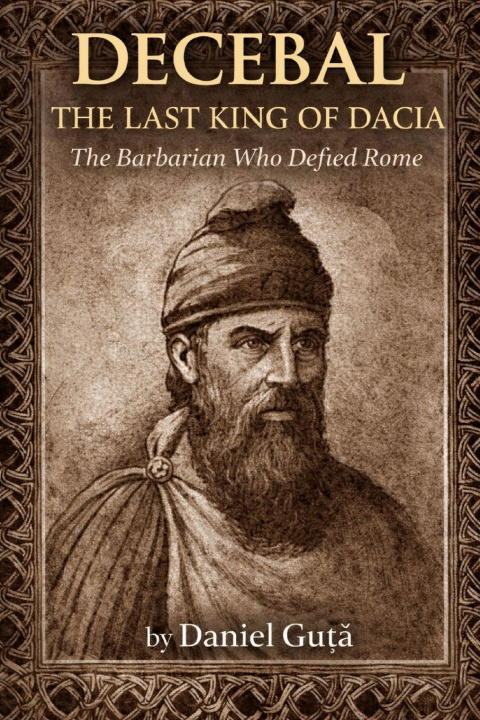
For most Romanians, Decebal stands as the emblematic figure of their ancient past. More than a historical character, he has become a symbol of resistance, dignity, and defiance at the eastern edge of Europe, where the Carpathian Mountains confronted the ambitions of the greatest empire of antiquity.
Decebal was the last king of Dacia and one of the most compelling figures of the ancient world: a ruler who led his people through some of the fiercest confrontations of his age and who chose death over submission when defeat became inevitable. After his fall, part of his kingdom was absorbed into the Roman Empire, yet his memory survived conquest and centuries alike.
His reign unfolded at a moment of profound danger for the Dacian world. Lasting roughly two decades, it coincided with the relentless expansion of Rome, whose legions were advancing steadily toward the Danube and beyond. Dacia occupied a strategic and resource-rich territory, corresponding largely to present-day Romania-both a threat and a prize for Rome, and a homeland that Decebal was determined to defend at all costs.
Ancient historians portrayed him as an adversary worthy of Rome itself. The Roman historian Cassius Dio described Decebal as a master of warfare, skilled in both attack and retreat, courageous in battle, clever in setting traps, and capable of turning even defeat into survival. This was not the image of a reckless barbarian, but of a strategist who understood terrain, timing, and psychology as well as any Roman general.
According to ancient sources, Decebal came to power during a time of crisis, succeeding King Duras, who voluntarily stepped aside to allow a more capable leader to confront the Roman threat. Archaeological and epigraphic evidence suggests that Decebal was the son of King Scorilo, firmly placing him within the ruling elite of Dacia. His accession marked a period of consolidation, military reform, and the strengthening of fortifications centered on Sarmizegetusa Regia, the political and spiritual heart of the kingdom.
Under Decebal, Dacia was smaller in extent than it had been under the earlier king Burebista, yet more cohesive and better organized. Its borders were defined by natural frontiers-the Danube, the Carpathian Mountains, and major river systems-which Decebal transformed into a layered defensive network of fortresses, roads, and supply routes that repeatedly frustrated Roman advances.
Conflict with Rome came quickly. During the reign of Emperor Domitian, Roman forces crossed the Danube confident in their superiority, only to be ambushed and crushed in the mountain passes of Tapae. An entire Roman legion was annihilated, along with its commander-an event that shocked the empire. It was after these victories that Decebal adopted the name by which he would be remembered, commonly interpreted as meaning "the brave" or "the strong."
Even in moments of apparent defeat, Decebal proved capable of turning loss into advantage. A peace treaty granted him the status of a client king, but also brought Roman subsidies, engineers, and military instructors into Dacia. Rather than weakening his realm, this arrangement allowed Decebal to modernize his defenses and army, learning from Roman methods while preparing for the conflict he knew would inevitably return.
Legend and history intertwine in accounts of his stratagems: forests turned into illusions of armies, calculated retreats that exhausted Roman troops, and escapes achieved through intelligence rather than brute force. Whether all such tales are factual or not, they reflect how deeply Decebal's reputation for cunning and resilience impressed both his enemies and later generations.


Információ a könyvről
Angol

Ajándékozza oda ezt a könyvet még ma
Nagyon egyszerű
1 Tegye a kosárba könyvet, és válassza ki a kiszállítás ajándékként opciót 2 Rögtön küldjük Önnek az utalványt 3 A könyv megérkezik a megajándékozott címéreSzia! Libroamiko vagyok, a könyvtanácsadód.
Miben segíthetek?