
 Kapcsolat
 Hogyan vásároljunk
Kézbesítés
Vásárlási tanácsadó
 Angol
Angol
 247 b
247 b
 Új
Új
Akár 30 napos visszaküldési lehetőség

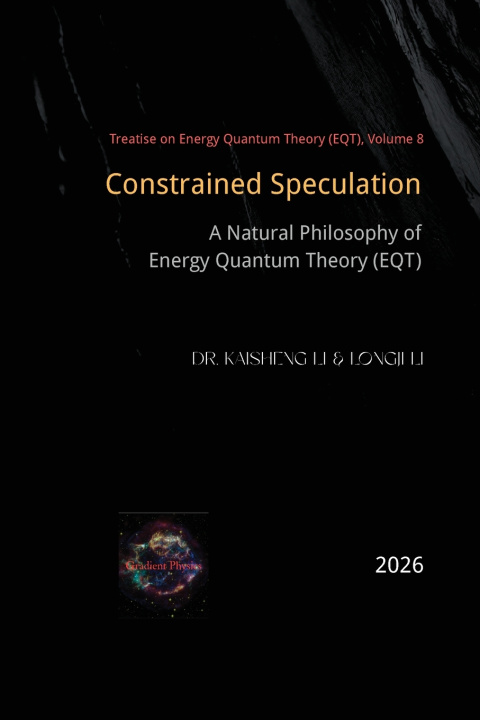
This book develops a systematic philosophy of nature at the boundary between physics, metaphysics, and the humanities. It is not a technical extension of the five-volume project on Energy Quantum Theory (EQT), but an independent philosophical work prompted by that project: an attempt to articulate the conceptual, ontological, and normative implications that emerge when physical theory is pursued to its limits.
At the center of the book is the method of constrained speculation. The book argues that metaphysical thought need not abandon speculation, but speculation becomes philosophically legitimate only when disciplined by formal articulation, mechanistic intelligibility, observational anchoring, and explicit failure conditions. On this basis, it proposes a criterion of ontological commitment: something is ontologically real insofar as its commitment has definable conditions under which it could fail. This shifts realism away from simple correspondence and toward a disciplined account of commitments, limits, and testability.
The ontology developed from this method may be called constrained process realism. It rejects the priority of static substances and treats beings as structured processes: differences, gradients, frequencies, three-state formations, co-evolutionary relations, and freezing transitions. Entities are not self-sufficient substances but relatively stable formations generated by dynamic processes. "Freezing" is therefore not cessation, equilibrium, or disappearance, but a basic ontological process through which active dynamics withdraw into residual structures, backgrounds, and histories.
The book unfolds this position across five movements. The first clarifies constrained speculation and its relation to falsifiability, ontological parsimony, and constitutive coextension. The second defends a gradient ontology in which difference precedes identity, frequency becomes an ontological dimension, and the three states of freedom, binding, and condensation function as basic categories of being. The third develops a relational ontology of co-evolution, applying it to mind-matter unity, observation, objectivity, and time. The fourth examines the metaphysical boundary of freezing, culminating in the gradient end state as an internal ontological singularity. The fifth turns to normativity, asking how meaning, value, and human dignity remain possible under ultimate finitude.
A central thesis of the book is that meaning exists before freezing. Physically, this refers to the interval in which gradients persist and structured processes remain active. Philosophically, it means that meaning depends on the capacity to maintain distinctions, make choices, and sustain direction. Humanistically, it affirms that finitude does not weaken meaning but constitutes its condition of truth. Meaning is real not because it is eternal, but because it is finite, vulnerable, selective, and alive.
The book engages Popper, Quine, Davidson, Whitehead, Cartwright, Ladyman, Floridi, Rovelli, Heidegger, Wittgenstein, Hume, Moore, Chalmers, and Barad, while also drawing on Chinese philosophy, especially qi theory, the Yijing tradition, Huayan Buddhism, Madhyamaka, and Confucian practical wisdom. Its aim is not to reduce these traditions to EQT, nor to claim that they anticipated modern physics, but to place them in a disciplined cross-cultural conversation about process, relation, finitude, and meaning.
Ultimately, the book argues that philosophy is not a residue left behind by science, but something called forth when science reaches its deepest conceptual boundaries. When physics pursues the limits of its own assumptions, it encounters questions that are no longer purely physical: being, objectivity, failure, value, and the dignity of finite existence. At that boundary, natural philosophy returns-not as a retreat from science, but as its rigorous continuation.


Információ a könyvről
Angol

Ajándékozza oda ezt a könyvet még ma
Nagyon egyszerű
1 Tegye a kosárba könyvet, és válassza ki a kiszállítás ajándékként opciót 2 Rögtön küldjük Önnek az utalványt 3 A könyv megérkezik a megajándékozott címéreSzia! Libroamiko vagyok, a könyvtanácsadód.
Miben segíthetek?