
 Kapcsolat
 Hogyan vásároljunk
Kézbesítés
Vásárlási tanácsadó
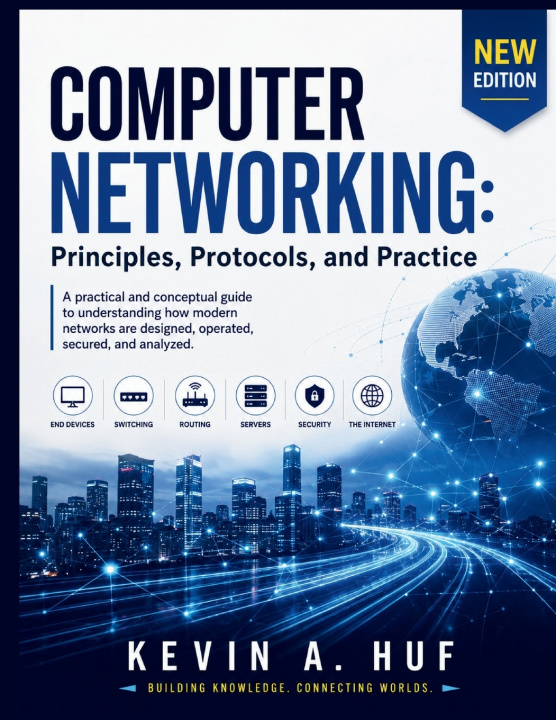
COMPUTER NETWORKING
Principles, Protocols, and Practice: A practical and conceptual guide to understanding how modern networks are designed, operated, secured, and analyzed.
 Angol
Angol
 224 b
224 b
 Hamarosan
 Új
Új
Akár 30 napos visszaküldési lehetőség

Reading about a protocol and being able to apply it under real conditions are two very different skills. A network professional needs to explain why a mechanism exists, predict how it will behave under load or failure, and decide what evidence would confirm or reject a hypothesis during troubleshooting.
This guide is built around that kind of applied understanding. Rather than presenting networking as a sequence of facts to memorize, it walks through the reasoning behind addressing, switching, routing, transport behavior, wireless design, security controls, and modern network architectures, then reinforces each concept with worked examples, practice questions, and realistic scenarios.
Working through this guide, readers will practice and apply:
- Calculating transmission delay, propagation delay, and subnet sizes using the same equations and reasoning used in professional network planning.
- Designing addressing schemes that support growth, route summarization, and clear organizational boundaries rather than ad hoc numbering.
- Evaluating switching, VLAN, and routing design choices against real requirements such as redundancy, broadcast domains, and failure tolerance.
- Applying transport-layer reasoning to explain why TCP and UDP behave differently and how that difference affects application performance.
- Diagnosing wireless performance and coverage issues by separating radio-environment factors from addressing or routing problems.
- Evaluating security controls, including access control, encryption, and network segmentation, against the specific risks they are meant to address.
Every major chapter closes with worked examples and practice problems accompanied by complete answer keys, so readers can test their understanding immediately rather than waiting until the end of the book. Key terms and equations are summarized at the end of each chapter for quick review and reference.
Topics covered include layered network models, physical transmission, data link and switching fundamentals, VLANs, IPv4 and IPv6 addressing and subnetting, routing protocols and behavior, the Internet Protocol suite, TCP and UDP transport mechanics, application and naming services, wireless and mobile networking, network security fundamentals, network monitoring and troubleshooting methodology, network design and performance planning, and modern architectures including virtualization, software-defined networking, and cloud and edge networking.
This guide is intended for readers who want to move beyond passive reading into applied practice: students preparing for hands-on networking work, career changers building practical skills, and IT professionals who want a structured way to sharpen design and troubleshooting judgment.
Add this practical resource to your library and start applying the reasoning, calculations, and troubleshooting methods covered inside.


Információ a könyvről
Angol
