
 Kapcsolat
 Hogyan vásároljunk
Kézbesítés
Vásárlási tanácsadó
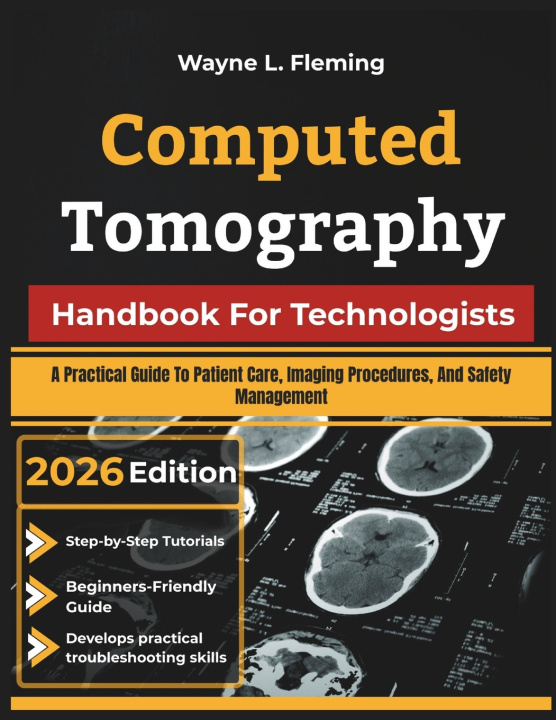
Computed Tomography Handbook For Technologists
A Practical Guide To Patient Care, Imaging Procedures, And Safety Management
 Angol
Angol
 225 b
225 b
 Új
Új
Akár 30 napos visszaküldési lehetőség

Does CT imaging feel overwhelming the moment you start dealing with kilovoltage, milliampere-seconds, contrast timing, reconstruction algorithms, artifact patterns, dose metrics, and protocol design - all at once, all under clinical time pressure?
Are you looking for a clear, current, and professionally authoritative guide that teaches computed tomography the way it is actually understood, practiced, and advanced by real CT technologists working at the highest level of the field today?
Computed Tomography Handbook For Technologists is your complete, hands-on guide to mastering the science, practice, patient care, and professional dimensions of CT imaging - fully aligned to the ARRT CT Examination Content Specifications.
Inside This Handbook, You Will Learn How to:
- Understand the physics of X-ray production, beam-matter interaction, attenuation, and the Hounsfield unit scale - the language CT speaks - explained with genuine depth and clinical relevance
- Trace the full arc of CT scanner technology from rotating anode design and slip-ring engineering through multi-detector configurations, dual-source geometry, and photon-counting detectors - and understand what each advance means for image quality and clinical capability
- Master photon-counting CT (PCCT) - the most significant advance in CT detector technology in decades - including its principles, clinical advantages, commercial systems, and operational implications for the CT technologist
- Optimize every acquisition parameter - kV, mAs, pitch, collimation, rotation time, FOV, and reconstruction algorithm - with the physical understanding that makes intelligent protocol adaptation possible
- Apply filtered back projection, iterative reconstruction, and deep-learning reconstruction with knowledge of their noise characteristics, dose efficiency, and clinical trade-offs
- Execute CT imaging procedures across every major body region - brain, stroke, and CT perfusion; cerebral CTA; facial bones and sinuses; soft tissue neck with mandatory IV contrast; larynx and airway CT (new 2026 requirement); temporal bone; chest and cardiovascular; coronary CTA; abdomen and pelvis; CT colonography (new 2026 requirement); CT enterography; esophagram with oral contrast (new 2026 requirement); liver and pancreatic protocols; CT urography; and pelvic oncology
- Master dual-energy CT and spectral imaging - the physics of material decomposition, the three technical implementations (dual-source, rapid kV switching, dual-layer), virtual monoenergetic images, iodine maps, and the clinical applications in gout, stone characterization, pulmonary embolism, and oncology
- Design, execute, and document a complete CT quality assurance program - daily, weekly, and monthly QA testing - and apply ACR CT accreditation standards and phantom-based performance testing
- Troubleshoot image quality problems systematically - from noise and artifact characterization through technical information collection, hypothesis testing, corrective action, and documentation
- Navigate the September 2026 ARRT CT examination blueprint - domain weights, new content additions, updated clinical experience requirements, and examination strategy - with the most current available guidance
More Than a Textbook - A Current, Comprehensive Professional Reference
Whether you are building your foundation, preparing for certification, updating your knowledge for a new scanner installation, or positioning yourself as the technical expert your department depends on, this handbook gives you the depth, the currency, and the clinical relevance that the demands of modern CT practice require.
If you are ready to master computed tomography with the clarity, confidence, and professional depth the field demands - scroll up and get your copy today.


Információ a könyvről
Angol

Ajándékozza oda ezt a könyvet még ma
Nagyon egyszerű
1 Tegye a kosárba könyvet, és válassza ki a kiszállítás ajándékként opciót 2 Rögtön küldjük Önnek az utalványt 3 A könyv megérkezik a megajándékozott címéreSzia! Libroamiko vagyok, a könyvtanácsadód.
Miben segíthetek?