
 Kapcsolat
 Hogyan vásároljunk
Kézbesítés
Vásárlási tanácsadó
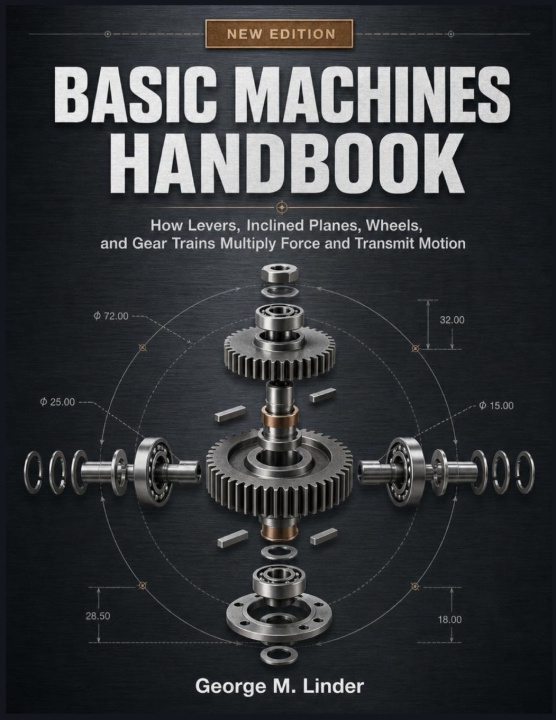
BASIC MACHINES HANDBOOK
How Levers, Inclined Planes, Wheels, and Gear Trains Multiply Force and Transmit Motion
 Angol
Angol
 162 b
162 b
 Hamarosan
 Új
Új
Akár 30 napos visszaküldési lehetőség

There are more machines in a workshop than anyone can memorise, and only a handful of principles behind all of them.
That is the difficulty most people meet when they set out to learn machinery. A hoist, a gearbox, a screw jack, a hand press and a bicycle drive get taught as separate devices, each with its own rules and its own formula, and the list never stops growing. Books that stop at the six classical simple machines leave a reader unable to read a real gearbox; trade manuals that go straight to the equipment leave a reader copying procedures without knowing why the numbers come out as they do. On a shop floor or in an examination, describing a machine is not enough.
This handbook closes that gap with fewer principles understood more thoroughly. A machine cannot create work. Whatever it gains in force it surrenders in distance, the ratio of that exchange is fixed by geometry and can be read off a drawing, and the difference between the exchange the geometry promises and the one the machine delivers is friction. Every chapter applies those few statements to one arrangement of parts, quantitatively: each principle is stated in words, developed as an equation with every symbol and unit defined, applied in worked examples that show each substitution, and handed over as practice problems whose answers you can check.
What this handbook helps you do
- Build from force, work, energy and power to free-body diagrams, equilibrium and the tipping condition, so every later analysis rests on something you have proved.
- Calculate mechanical advantage, velocity ratio and efficiency for levers, wheel-and-axle drives, tackles, ramps, wedges and power screws, and compound them correctly through a multi-stage drive train.
- Recognise the simple machine inside every machine element, from a gear pair renewing a lever tooth by tooth to an inclined plane wrapped around a cylinder and a press whose arms are made of fluid.
- Size gear pairs and trains, lay out belt and chain drives with wrap angle and service factors, and work shafts, clutches, brakes, bearings and hydraulic circuits with the same method.
- Read the hazard in an element from its physics: a screw that overhauls, an anchor carrying more than the load, a brake that fades as it heats, a nip point that draws a hand in.
It is written for first-year engineering and engineering-technology students who need derivations without gaps, for apprentices, millwrights and maintenance technicians who need the same physics anchored to equipment they actually touch, and for self-directed readers rebuilding a mechanics foundation. Safety is treated as engineering rather than exhortation.
Open the book at the first chapter and start building the habit that turns a machine into a diagram, and a diagram into a number you can defend.


Információ a könyvről
Angol
Kategória
