
 Kapcsolat
 Hogyan vásároljunk

Kézbesítés
Vásárlási tanácsadó
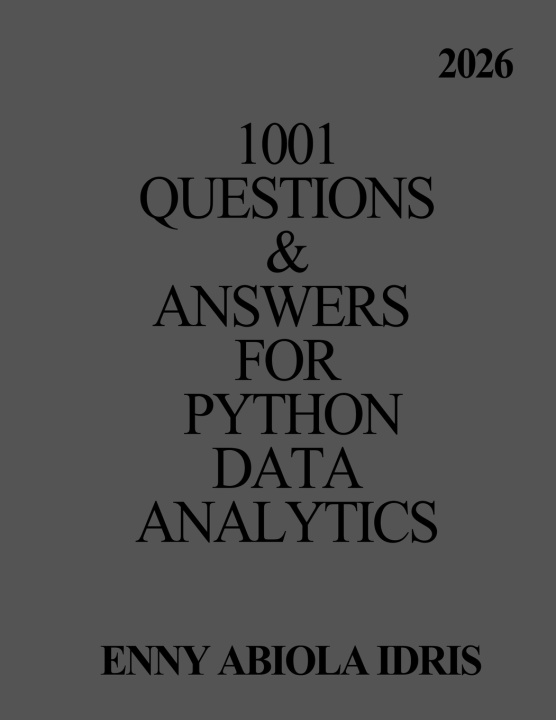
1001 QUESTIONS & ANSWERS FOR PYTHON DATA ANALYTICS
 Angol
 31 b
 Új
Akár 30 napos visszaküldési lehetőség

Data is an important resource in modern organisations. Businesses use it to understand customers, monitor sales, manage inventory, evaluate performance, identify trends, and make decisions. Governments, educational institutions, healthcare providers, financial organisations, and other industries also rely on data to understand problems and improve their operations.
However, collecting data is only one part of the process. The ability to organise, clean, analyse, interpret, and communicate information is what makes data useful.
Python has become a valuable programming language for these tasks because of its readable syntax and its extensive collection of libraries for data manipulation, numerical computing, statistical analysis, and visualisation.
For someone learning data analytics, Python offers opportunities to move beyond manual calculations and repetitive tasks. It can be used to process large datasets, identify patterns, calculate performance measures, create charts, and support evidence-based decisions.
Nevertheless, learning Python data analytics requires more than reading code examples. Learners need opportunities to answer questions, solve problems, test solutions, and understand the reasoning behind the results.
This is the purpose of 1001 Questions and Answers for Python Data Analytics
A Practical Approach to Learning
This book takes a question-and-answer approach to learning. Rather than presenting the subject through lengthy theoretical chapters, it focuses on questions, answers, and explanations.
Each question is designed to address a particular concept, task, programming technique, or data analytics problem. The answer follows the question, and a reason explaining why the answer is correct appears at the end of the question-and-answer unit.
This structure encourages active participation. Readers can attempt a question, compare their solutions with the answer, and use the explanation to understand the logic involved.
The questions also provide opportunities to practise reading Python code, predicting outputs, identifying errors, selecting appropriate methods, and applying data analytics techniques to practical situations.
What You Can Expect to Learn
The questions cover areas of Python programming and data analytics, including fundamental programming concepts, Python data structures, functions, numerical computing, Pandas, data cleaning, data transformation, data aggregation, statistical analysis, visualisation, and practical problem-solving.
The aim is to help readers connect programming techniques with the tasks data analysts perform.
For example, knowing how to create a DataFrame is useful, but being able to identify missing values, group sales by region, calculate total revenue, compare performance, and communicate the findings is even more valuable in an analytical setting.
Similarly, knowing the syntax of a function is only the beginning. A learner must also recognise when a function is appropriate, how to use its arguments, and how its output contributes to solving a problem.
Through its questions and explanations, this book aims to strengthen both technical understanding and practical reasoning.
Who Should Read This Book?
This book is intended for beginners learning Python data analytics, students preparing for assessments, aspiring data analysts, professionals refreshing their skills, and learners who want additional practice beyond conventional lessons.
Readers with no previous programming experience may need to consult a beginner Python resource when they encounter unfamiliar concepts. Those with some Python knowledge can use the questions to assess their understanding and identify areas for improvement.
The book can also serve as a supplementary resource for instructors, trainers, and mentors who need questions for practice sessions or revision.


Információ a könyvről
Angol

Ajándékozza oda ezt a könyvet még ma
Nagyon egyszerű
1 Tegye a kosárba könyvet, és válassza ki a kiszállítás ajándékként opciót 2 Rögtön küldjük Önnek az utalványt 3 A könyv megérkezik a megajándékozott címéreSzia! Libroamiko vagyok, a könyvtanácsadód.
Miben segíthetek?