
 Contact
 How to shop
Delivery
Shopping guide
 English
 298 b
298 b
Up to 30 days for returns
You might also be interested in



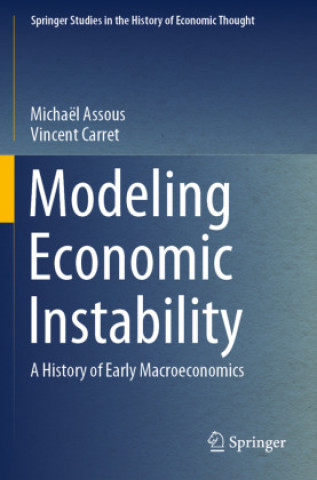
This book offers a fresh perspective on the early history of macroeconomics, by examining the macro-dynamic models developed from the late 1920s to the late 1940s, and their treatment of economic instability. It first explores the differences and similarities between the early mathematical business cycle models developed by Ragnar Frisch, Michal Kalecki, Jan Tinbergen and others, which were presented at meetings of the Econometric Society and discussed in private correspondence. By doing so, it demonstrates the diversity of models representing economic phenomena and especially economic crises and instability. Jan Tinbergen emerged as one of the most original and pivotal economists of this period, before becoming a leader of the macro-econometric movement, a role for which he is better known. His emphasis on economic policy was later mirrored in the United States in Paul Samuelson's early work on business cycles analysis, which, drawing on Alvin Hansen, aimed at interpreting the 1937-1938 recession. The authors then show that the subsequent shift in Samuelson's approach, from the study of business cycle trajectories to the comparison of equilibrium points, provided a response to the econometricians' critique of early Keynesian models. In the early 1940s, Samuelson was able to link together the tools that had been developed by the econometricians and the economic content that was at the heart of the so-called Keynesian revolution. The problem then shifted from business cycle trajectories to the disequilibrium between economic aggregates, and the issues raised by the global stability of full employment equilibrium. This was addressed by Oskar Lange, who presented an analysis of market coordination failures, and Lawrence Klein, Samuelson's first PhD student, who pursued empirical work in this direction. The book highlights the various visions and approaches that were embedded in these macro-dynamic models, and that their originality is of interest to today's model builders as well as to students and anyone interested in how new economic ideas come to be developed.


About the book
English

Give this book today
It's easy
1 Add to cart and choose Deliver as present at the checkout 2 We'll send you a voucher 3 The book will arrive at the recipient's addressHi! I'm Libroamiko, your book advisor.
How can I help you?