
 Contact
 How to shop
Delivery
Shopping guide
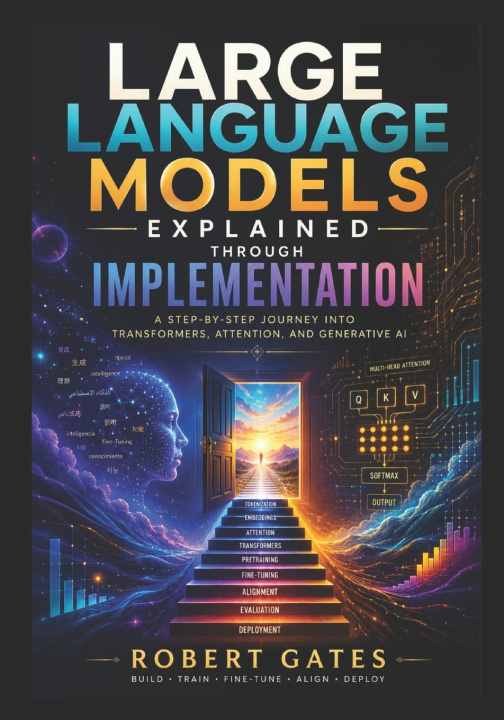
Large Language Models Explained Through Implementation
A Step-by-Step Journey into Transformers, Attention, and Generative AI
 English
 50 b
50 b
 New
New
Up to 30 days for returns

Discover how modern artificial intelligence actually works by building it from the ground up.
Large language models have transformed software development, research, business, and human-computer interaction. Yet for many developers and AI enthusiasts, these systems remain mysterious black boxes. Large Language Models Explained Through Implementation removes that mystery by taking you inside the architecture, algorithms, and engineering principles that power today's most advanced generative AI systems.
Written for developers, machine learning practitioners, researchers, and technically curious professionals, this comprehensive guide provides a practical, implementation-focused journey through the foundations and construction of modern large language models. Rather than simply explaining concepts, this book demonstrates how transformer-based systems work by exploring their components, architectures, training methodologies, optimization strategies, and deployment techniques in depth.
Beginning with the fundamental principles of language modeling, neural networks, and representation learning, the book progressively guides readers through tokenization, embeddings, attention mechanisms, transformer architectures, GPT-style model implementation, large-scale pretraining, fine-tuning, instruction alignment, evaluation, optimization, and deployment. Each topic is presented with a strong emphasis on conceptual understanding, practical implementation, and real-world engineering considerations.
Inside this book, readers will explore:
The foundations of large language models and generative artificial intelligence.
Text processing, tokenization, and embedding architectures.
Attention mechanisms and transformer design principles.
The implementation of GPT-style models from first principles.
Training pipelines, optimization strategies, and large-scale pretraining.
Fine-tuning techniques, instruction tuning, and model adaptation.
Reinforcement learning from human feedback and alignment methodologies.
Model evaluation, interpretability, compression, and optimization.
Retrieval-augmented generation and advanced AI applications.
Deployment architectures, production considerations, and future directions in generative AI.
Unlike introductory AI books that focus primarily on using existing tools and APIs, this book emphasizes understanding through implementation. By examining how each component functions and how these components interact to create intelligent systems, readers will develop the knowledge and intuition necessary to build, evaluate, customize, and extend large language models with confidence.
Whether the goal is to develop intelligent applications, conduct research, build domain-specific models, create AI agents, or gain a deeper understanding of modern artificial intelligence, this book provides the theoretical foundation and practical expertise required to navigate one of the most important technological revolutions of the twenty-first century.
The future of artificial intelligence belongs not only to those who use these systems, but to those who understand how to build them.


About the book
English

Give this book today
It's easy
1 Add to cart and choose Deliver as present at the checkout 2 We'll send you a voucher 3 The book will arrive at the recipient's addressHi! I'm Libroamiko, your book advisor.
How can I help you?