
 Contact
 How to shop
Delivery
Shopping guide
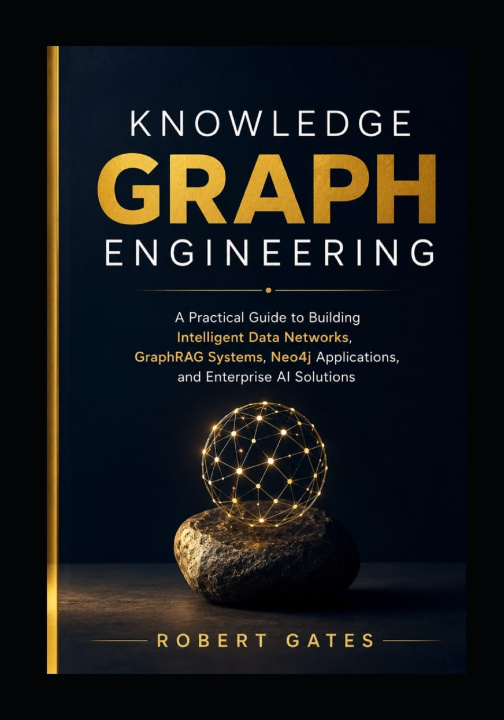
Knowledge Graph Engineering
A Practical Guide to Building Intelligent Data Networks, GraphRAG Systems, Neo4j Applications, and Enterprise AI Solutions
 English
 50 b
50 b
 New
New
Up to 30 days for returns

The future of artificial intelligence is not built on larger language models alone. It is built on connected knowledge.
As organizations generate unprecedented volumes of data, the real challenge is no longer collecting information-it is understanding the relationships hidden within it. Knowledge graphs have emerged as one of the most powerful technologies for transforming disconnected data into intelligent, context-aware systems capable of supporting advanced analytics, semantic search, enterprise automation, and next-generation AI.
**Knowledge Graph Engineering** is a comprehensive, hands-on guide that takes you from the core principles of graph-based knowledge representation to the design and deployment of production-ready knowledge graph solutions. Whether you are building enterprise applications, implementing GraphRAG pipelines, designing semantic architectures, or integrating large language models with structured knowledge, this book provides the technical foundation and practical guidance needed to build scalable, intelligent systems.
Beginning with the fundamentals of graph theory, semantic technologies, and knowledge representation, the book gradually explores RDF, RDFS, OWL, SPARQL, property graphs, Neo4j, Cypher, ontology engineering, and graph data modeling before advancing into enterprise-scale architectures, graph analytics, GraphRAG, AI agents, code knowledge graphs, and production deployment strategies.
Rather than focusing only on theory, every chapter bridges conceptual understanding with practical implementation. Real-world engineering scenarios, production best practices, architectural guidance, and complete implementation examples demonstrate how knowledge graphs solve complex challenges across industries including finance, healthcare, cybersecurity, software engineering, manufacturing, scientific research, enterprise search, recommendation systems, and intelligent automation.
Throughout the book, you will develop the skills required to design high-quality ontologies, integrate heterogeneous data sources, optimize graph queries, model complex business domains, build graph-powered AI applications, and deploy scalable knowledge graph platforms that remain reliable, maintainable, and adaptable as organizational needs evolve.
By the end of this book, you will be able to:
Design robust knowledge graph architectures for enterprise applications.
Model complex domains using semantic technologies and property graphs.
Build and query graph databases using Neo4j and Cypher.
Develop interoperable knowledge models with RDF, RDFS, OWL, and SPARQL.
Construct scalable knowledge graph ingestion and integration pipelines.
Apply graph analytics to uncover patterns, relationships, and insights.
Implement GraphRAG systems that improve context-aware AI retrieval and reasoning.
Build AI agents that leverage structured knowledge for intelligent decision-making.
Create code knowledge graphs for software analysis and AI-assisted development.
Deploy secure, scalable, and production-ready knowledge graph solutions using modern engineering practices.
Whether you are an AI engineer, software developer, data engineer, data architect, machine learning practitioner, enterprise architect, researcher, or technology leader, this book provides the practical knowledge and engineering mindset needed to design intelligent systems that understand not only data, but also the relationships that give data meaning.
If you are ready to move beyond isolated information and build the connected intelligence that powers modern AI and enterprise innovation, **Knowledge Graph Engineering** will become an essential resource on your professional bookshelf.


About the book
English

Give this book today
It's easy
1 Add to cart and choose Deliver as present at the checkout 2 We'll send you a voucher 3 The book will arrive at the recipient's addressHi! I'm Libroamiko, your book advisor.
How can I help you?