
 Contact
 How to shop
Delivery
Shopping guide
G Protein Methods and Protocols
Role of G Proteins in Psychiatric and Neurological Disorders
 English
 406 b
406 b
Up to 30 days for returns
Customers also purchased





 /
/
 Hardback
 23 431
Ft
23 431
Ft

















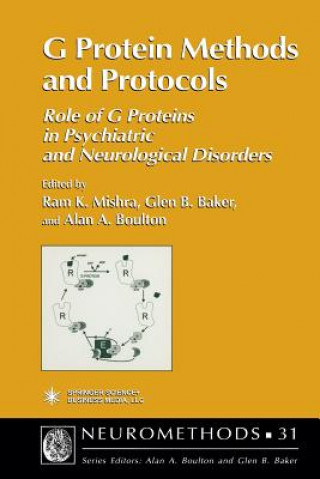
The G proteins are a family of structurally homologous, plasma membrane-associated guanine-nucleotide-binding proteins. These proteins play an integral role in the tra- duction of extracellular signals through second messenger systems. As such, G proteins affect a wide variety of intra cellular biochemical reactions by regulating the concent- tion of second messengers in cells. G proteins are heterotrimeric, consisting of a, p, and y polypeptide chains, with G protein specificity largely det- mined by the a-subunit, Molecular cloning of G protein s- units has revealed 23 distinct a-subunits, encoded by 17 different genes. Based on functional measures, G proteins are generally classified into three major categories: the G, family, which is stimulatory for adenylyl cyclase; the G, f- ily, which is inhibitory for adenylyl cyclase; and the G, f- ily, which stimulates phospholipases (Birnbaumer and Birnbaumer, 1995). Alternatively, on the basis of sequence homology, G proteins can be subdivided into four cate- ries: G,, G,, G,, and G12.


About the book
English

Give this book today
It's easy
1 Add to cart and choose Deliver as present at the checkout 2 We'll send you a voucher 3 The book will arrive at the recipient's addressYou might also be interested in





 /
Paperback
7 176
Ft
/
Paperback
7 176
Ft










 /
Hardback
73 493
Ft
/
Hardback
73 493
Ft
Hi! I'm Libroamiko, your book advisor.
How can I help you?